Pick up and Drop
Service Available

A Contrast CT Scan is an advanced form of computed tomography used when doctors need a clearer view of particular organs, tissues, or blood vessels. While a standard CT already produces detailed cross-sectional images, contrast material can create a stronger distinction between different internal structures. This can give the radiologist additional information when investigating a specific medical concern.
Yes, in some situations, a Contrast CT Scan can make certain changes easier to see than a routine CT performed without contrast. The contrast material helps create a clearer difference between tissues and can highlight blood vessels, organ enhancement, inflammation, infections, and some abnormal growths or masses. This additional detail can be valuable when a doctor is investigating a specific symptom or condition and needs to understand how tissues are receiving blood flow or how an abnormal area differs from surrounding structures.
However, contrast does not mean that every finding will be detected or that it is always necessary. A routine CT may be sufficient for many conditions, while a Contrast CT Scan is selected when the clinical question requires enhanced visualisation. The choice depends on the body region, suspected condition, medical history, and the information the doctor needs from the examination.
Not every CT examination requires contrast. Its use depends on what the doctor needs to investigate and which part of the body is being examined. A Contrast CT Scan may be recommended when additional visual detail is needed to assess specific structures or tissue changes.
A doctor may recommend contrast imaging when additional detail is useful for assessing:
Therefore, a Contrast CT Scan is not simply a “better CT.” It is a specifically selected imaging technique designed to answer particular diagnostic questions and provide information relevant to the patient’s clinical condition.
The procedure is generally straightforward. Before the examination, the imaging team may ask about your medical history and any previous reactions to contrast.
1. Patient assessment
Relevant medical information is reviewed before the examination.
2. Contrast preparation
If intravenous contrast is required, a small cannula is placed into a vein, usually in the arm.
3. Contrast administration
The contrast material is injected at the appropriate stage of the examination.
4. CT imaging
The patient lies on the scanning table while images are captured.
5. Image evaluation
The resulting images are reviewed by an appropriately qualified radiologist.
This process is commonly referred to as a CT Scan With Contrast, Contrast CT Examination, or Contrast Enhanced CT.
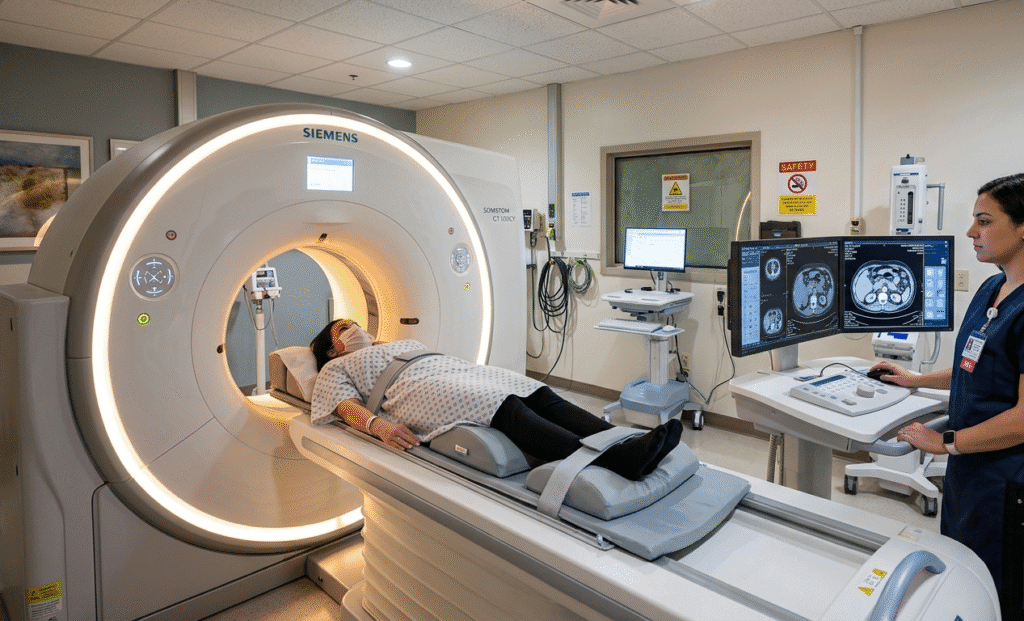
The main purpose of contrast is to make certain structures easier to distinguish from their surroundings. Iodine-based contrast is commonly used because it interacts strongly with X-rays.
When the contrast material moves through the bloodstream, structures containing more contrast can appear differently from nearby tissues. This can help the radiologist evaluate anatomical details that may otherwise have less visual separation.
In simple terms, Contrast-Enhanced Computed Tomography can add another layer of information to the CT images rather than merely producing a brighter picture.
An Iodine Contrast CT uses an iodine-containing contrast agent, commonly administered through a vein. It may be particularly useful when the examination requires better visualisation of blood vessels or tissue enhancement.
Some patients may briefly notice:
These sensations can occur shortly after injection and usually pass quickly. Patients should nevertheless tell the imaging staff if they experience anything unusual.
Before undergoing a Contrast Material CT Scan, patients should provide accurate information about their medical history.
Tell the imaging team if you have:
This information helps the medical team determine the appropriate preparation and whether additional precautions are needed.
This is a common question among patients. In certain situations, CT Imaging With Contrast can make specific abnormalities, blood vessels, or tissue differences more conspicuous than they may appear on non-contrast images.
However, contrast does not guarantee that every hidden abnormality will be detected. Its usefulness depends on the condition being investigated and the type of CT protocol used. The radiologist interprets the images together with the patient’s clinical information.
The quality of a CT examination is not determined only by the scanner. The examination needs to match the clinical question.
For example, the imaging team may need to consider:
Using the appropriate protocol can help ensure that the examination provides information relevant to the doctor’s concern.
When choosing a CT scan centre in Dehradun, patients should consider the overall diagnostic process rather than focusing only on the availability of a CT machine.
Important factors include:
A patient-friendly diagnostic environment can also make the experience less confusing, particularly for people undergoing contrast imaging for the first time.
Semwal Diagnostics Centre is a diagnostic imaging centre in Dehradun offering a range of imaging and diagnostic services. For patients referred for a Contrast CT Scan, the centre provides a structured setting where the examination can be carried out according to the recommended imaging requirements.
For people looking for a CT scan centre in Dehradun, Semwal Diagnostics Centre is a strong choice for organised diagnostic imaging, patient-focused guidance, and appropriate imaging evaluation.